
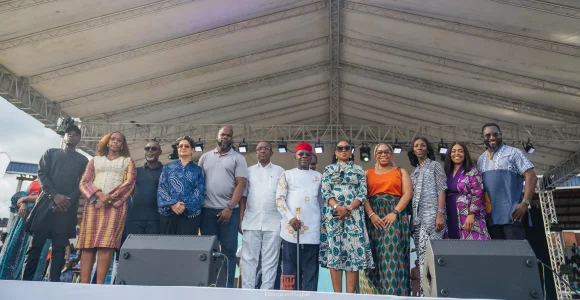
Aba, Nigeria - Ethnocentrique has successfully concluded the second edition of The Fashion Games, a two-day market activation marking the end of the pilot phase of the Fashion Future Programme (FFP), a Mastercard Foundation programme implemented in partnership with Ethnocentrique.
The Fashion Games 2026 marked a documented milestone for the FFP: women make up over 80% of participants, over 10,000 primary and secondary jobs have been created, and 282 persons with disabilities have launched businesses through the programme, figures that reflect the deliberate design of the infrastructure being built.
Day one convened government, financial institutions, fashion industry stakeholders, and FFP-led MSMEs to tackle how Nigeria's fashion sector can scale sustainably. In the first panel session of the day, "Meeting Market Demand at Scale: Structuring Production Systems for Youth Employment and Enterprise Growth in Fashion," conversations underscored a critical truth: talent is abundant, but systems are not. From production inefficiencies and inconsistent quality standards to limited access to structured financing, stakeholders agreed that scaling fashion requires coordinated systems, not just skill.
The second panel session, "Financing Growth at Scale: Expanding Access for Youth-led Creative MSMEs and Fashion Enterprises," examined barriers to finance, with stakeholders stressing that stronger governance, record-keeping, and business structure are critical for MSMEs to unlock funding.
Speaking at the event, Jeremiah Ubunamah, Programme Coordinator of the Fashion Future Programme (FFP), said:
"When we came to Aba, we asked a simple question: what if we stop seeing fashion as style and start seeing it as an economy? Since then, we've reached 10,379 people across Aba and its surroundings, with 6,000-plus of them participating in the FFP. We've also supported the creation of over 4,000 MSMEs, and processed over ₦200 million in orders. Ahịa 360 is not a convening; it is a market activation platform."
Also speaking at the event, Ethnocentrique CEO Irunna Ejibe emphasised the need for alignment:
"Ecosystems don't fail from lack of effort, but from lack of coordination. The fragmentation must stop. What we've built is a model that connects skills, finance, policy, and enterprise into one clear pathway."
Speaking further, Ejibe highlighted what the model produced on the ground:
"We have created the MCIPP in partnership with the Abia State Government, which is a coordinated platform that has helped bring structure to over 4,000 small businesses. An MSME steering committee in Aba has also been created to align actors across government, finance, and enterprise. We've also been able to cluster 99 MSMEs into registered cooperatives with the governance structure needed to access financing that would have otherwise been out of reach."
Day one also featured a youth-led runway, a business pitch competition with cash prizes, and a landmark market agreement between the Abia State Ministry of Sports and Youth Development and Ethnocentrique to source locally from Aba.
Day two delivered a vibrant parade and powerful testimonials. Rosy Fynn, Country Director Nigeria at the Mastercard Foundation, noted that the programme has already exceeded its targets, with documented results across economic participation, inclusion, and enterprise formation for young women and persons with disabilities.
In the same vein, Governor Alex Otti reaffirmed the state's commitment to supporting local production, positioning Aba as a competitive force in the global fashion industry.
Since its inception, the Fashion Future Programme has trained and certified over 6,000 young people using the National Skills Qualifications Framework (NSQF), and has established over 100 Business Development Service Providers who have trained 4,240 MSMEs in Abia State.
As the team draws the curtains on the pilot phase, the model has been documented and proven. Africa's fashion will not be built on creativity alone; the work in Aba has shown what coordinated systems can do at scale. Now it's time to deploy.
ABOUT ETHNOCENTRIQUE LIMITED
Ethnocentrique builds the full infrastructure stack, skills, finance, markets, and policy for fashion's human capital in Nigeria. Its work spans the complete local fashion loop: garments, footwear, bags, slippers, leather goods, and accessories. Its programmes include the Fashion Future Programme (FFP) , a Mastercard Foundation programme implemented in partnership with Ethnocentrique, African Cobblers Ltd, Ethnocentrique Arts, and The Fashion Games.